Week 8
I realized filling has a direction. People’s interpretations can gather toward a shared standard, or branch out from the same start. This connected my starting point, idealization in long-distance relationships, to AI: an AI’s first answer can quietly become everyone’s shared standard.
I also separated two kinds of blanks. Broken is when a filled-in picture has to match reality, like a reunion. Blank is when there’s no single answer, so being different is okay. My design work belongs to the second.
Week 7
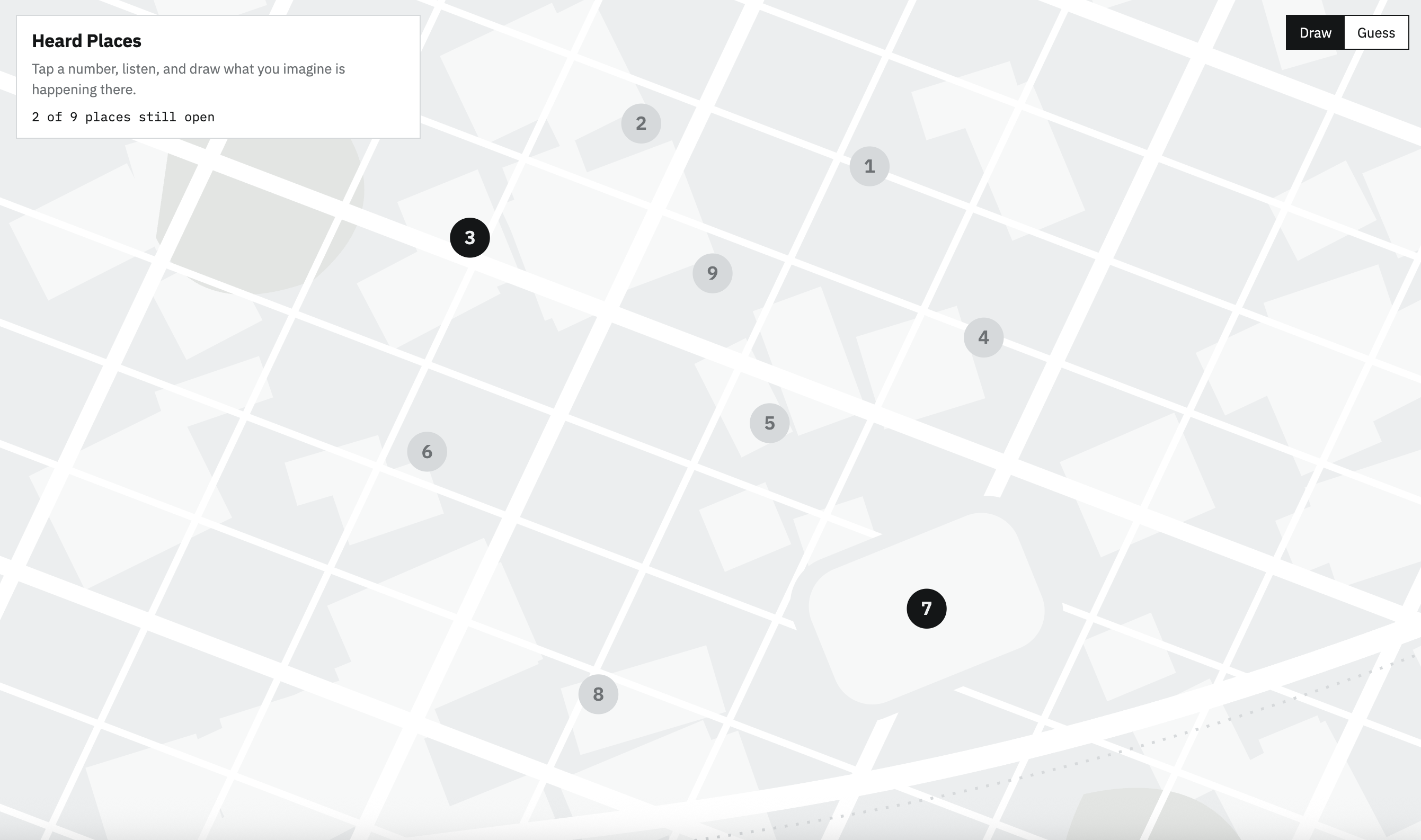
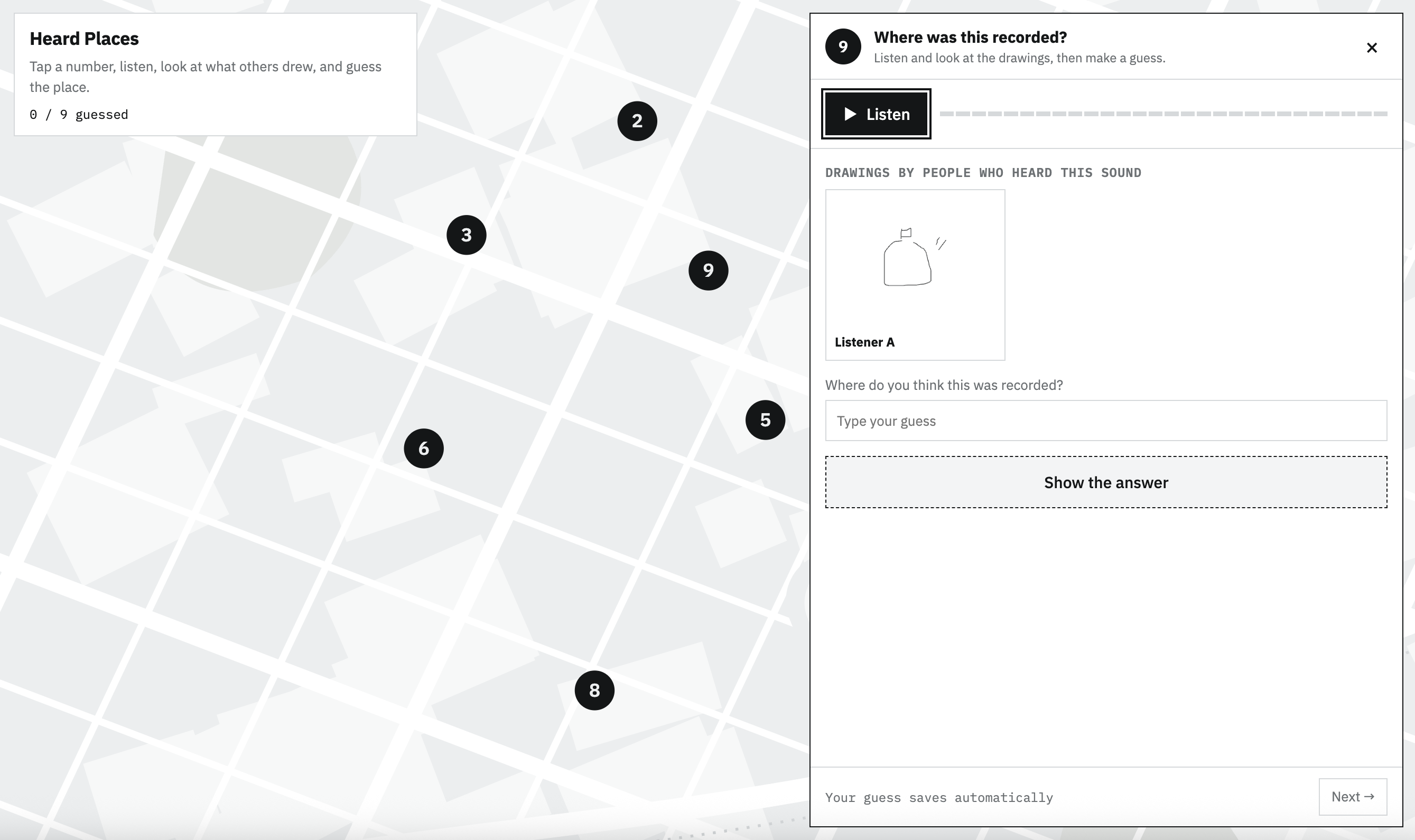
I built a cultural probe called Heard Places, a map with nine points and no photos or names. Each point plays a sound I recorded myself, such as a plastic bag, a ventilation fan, a laundry room, an elevator, a concert, and a door closing. Participants listen and draw what they think is happening there. While choosing the sounds, I noticed that the most recognizable ones leave the least room to imagine. A concert crowd immediately reads as “concert,” while a fan or the quiet after a door closes could be almost anything. What surprised me was that the ambiguous, everyday sounds felt the most promising, not the dramatic ones. I also realized the map itself can give away too much, so I had to hide visual hints to keep the space open.
Week 5
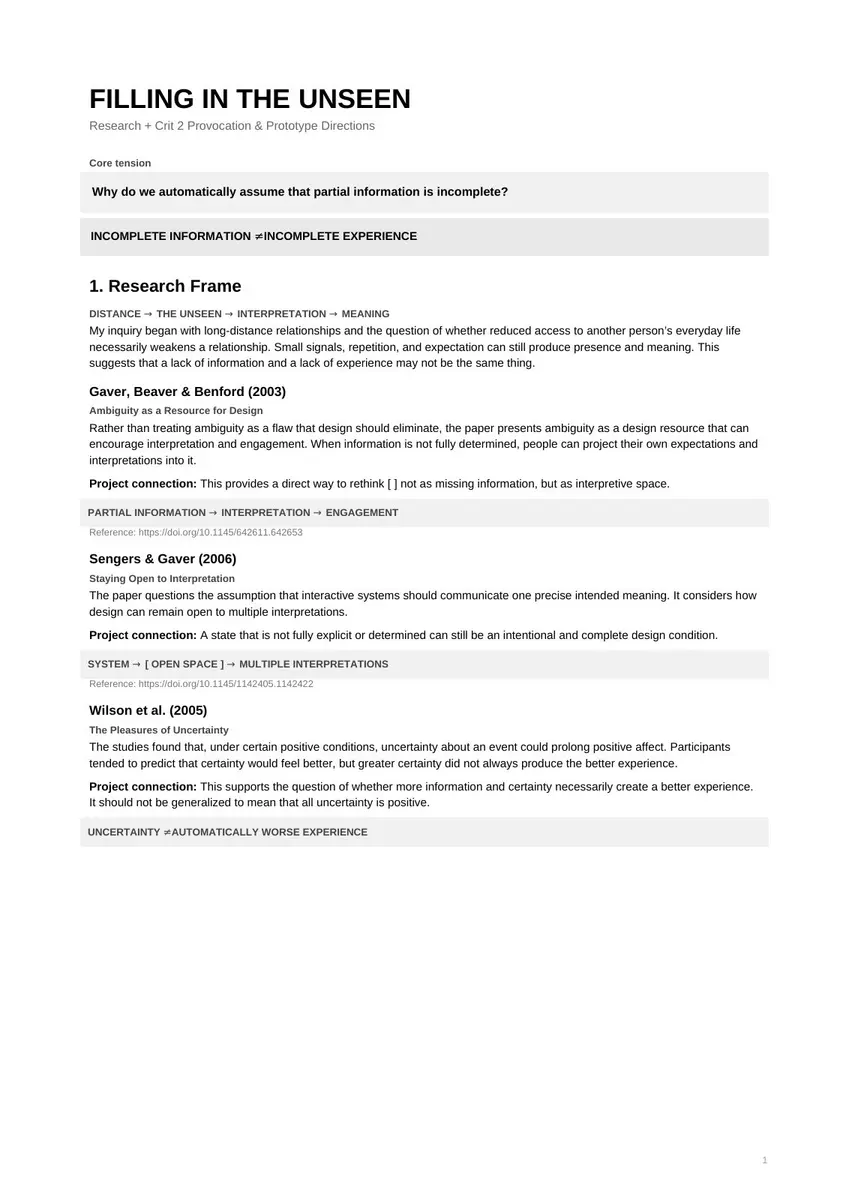
Through my research, I explored how **partial information, ambiguity, and absence can still create meaningful experiences**. I initially thought that missing information naturally made an experience incomplete, but I discovered that people often use interpretation, expectation, and imagination to fill what is unseen. What surprised me most was that **more information does not always create a better or more complete experience**. This shifted my focus from asking how to fill missing information to asking **how much information is actually enough** and what can happen when technology intentionally leaves space for interpretation.
Week 4
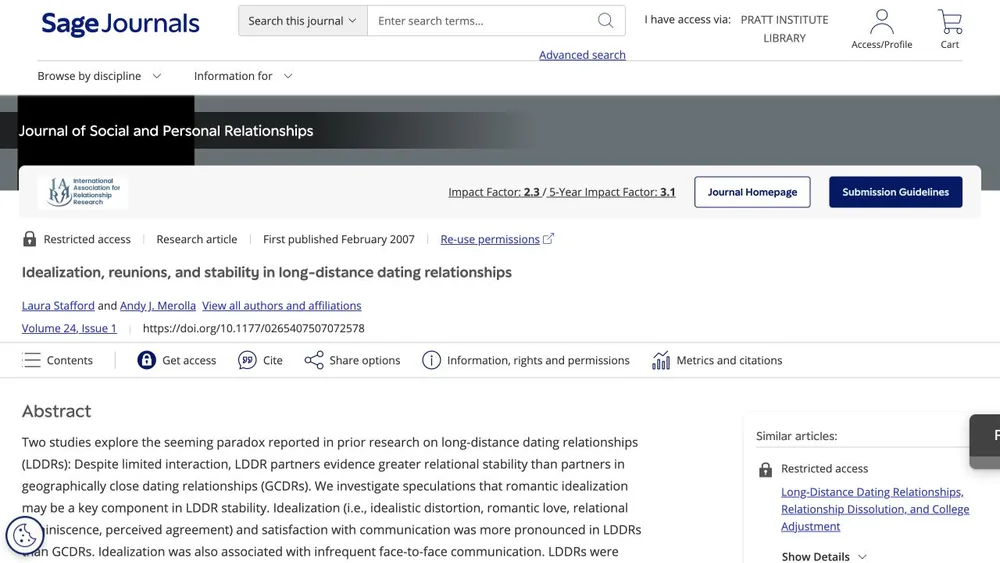
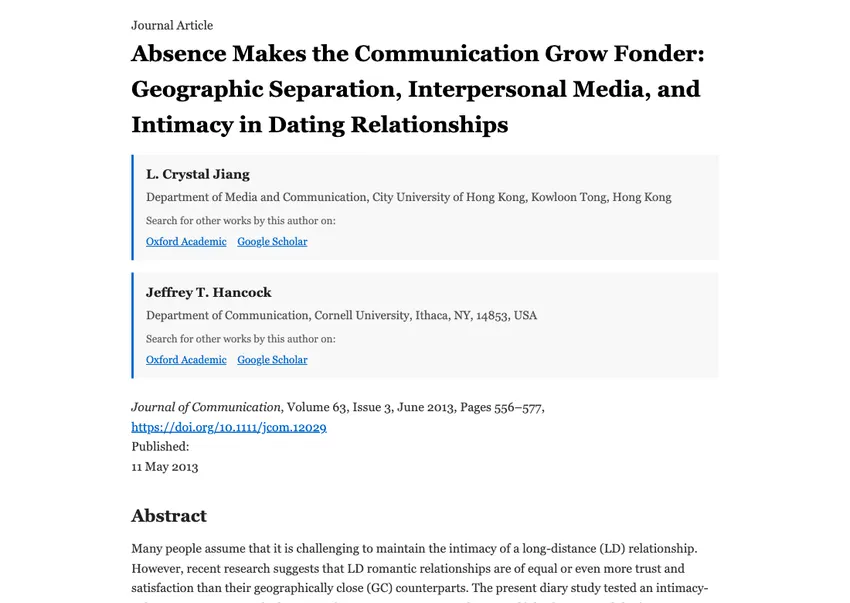
Through my research, I discovered that physical presence does not necessarily create intimacy, and repeated communication can gradually become a habit. What surprised me most was how limited information about a partner’s daily life can encourage imagination and shape an idealized image of them. This made me realize that distance does not simply separate people but can also create space for imagination. I now want to explore how this process of idealization extends beyond romantic relationships to places, products, and lifestyles.
Week 3
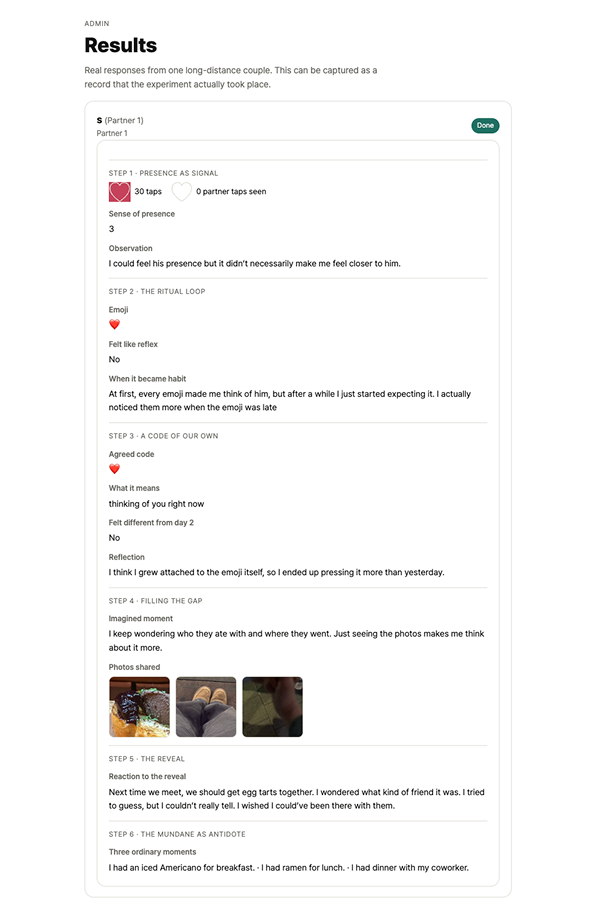
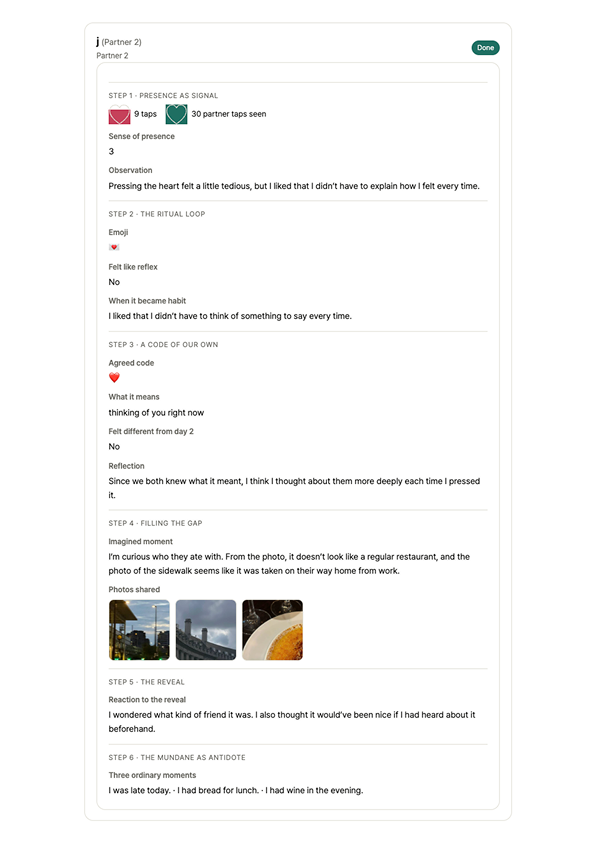
I conducted a six-day rapid-prototyping study with a real long-distance couple, Soomin and Jaehyun. Each participant used their own device and moved through six connected experiments, with their responses recorded in real time. The first three prototypes explored signals and shared meaning. Day 1 removed the content of communication and kept only a signal of presence. Day 2 repeated that signal to test how ritual develops over time. Day 3 introduced a meaning that the couple had agreed on together. Days 4–6 shifted toward imagination and everyday information. Participants imagined their partner’s situation from blurred photographs, compared those assumptions with what had actually happened, and finally shared only three simple sentences about their day.
Week 2
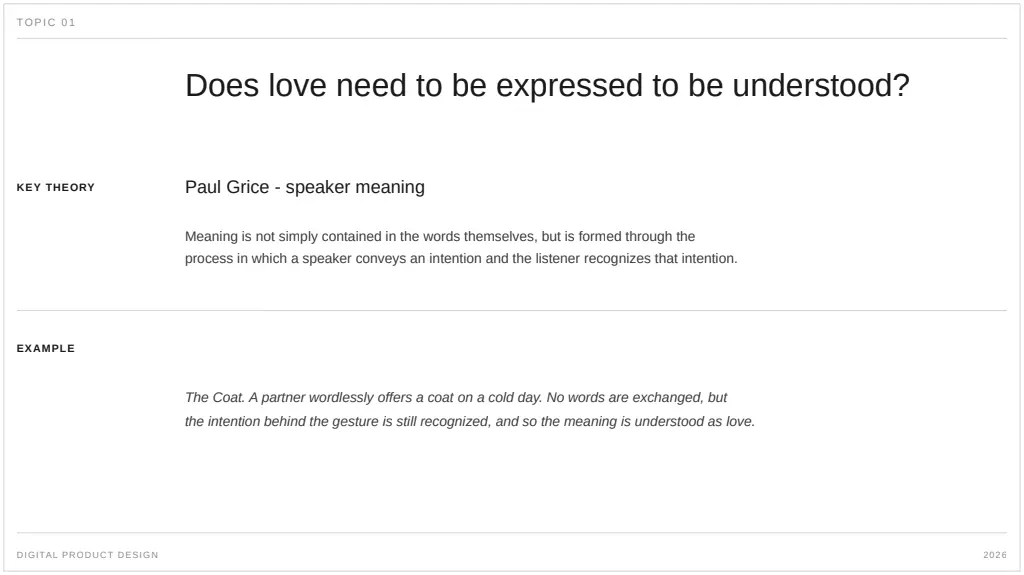
I started from Grice's idea that love is understood when a sender's intention is recognized, like a coat quietly offered on a cold day. But the coffee example broke that assumption: someone makes it out of habit, with no intention to say "I love you," yet the partner still experiences it as love. That surprised me. Meaning didn't come from intention alone; it was built afterward, through interpretation and repetition, closer to a private idiom than a message.
Luhmann pushed this further. He argues love isn't a raw feeling that culture just dresses differently. Culture builds the code itself, the grammar deciding what even counts as love, and that code has been rewritten across history. The real surprise: love, which feels like the most personal and spontaneous thing, turns out to be one of the least natural.
So my question has shifted from "does love need intention" to "who authors love's meaning: the speaker, the interpreter, the culture, or the relationship itself."
Week 1
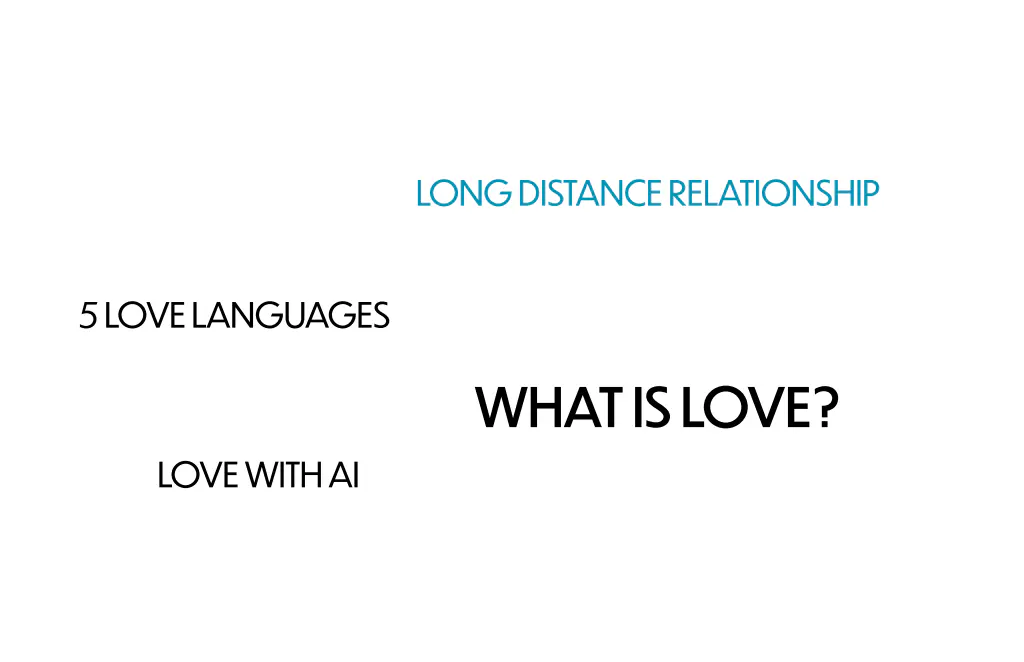
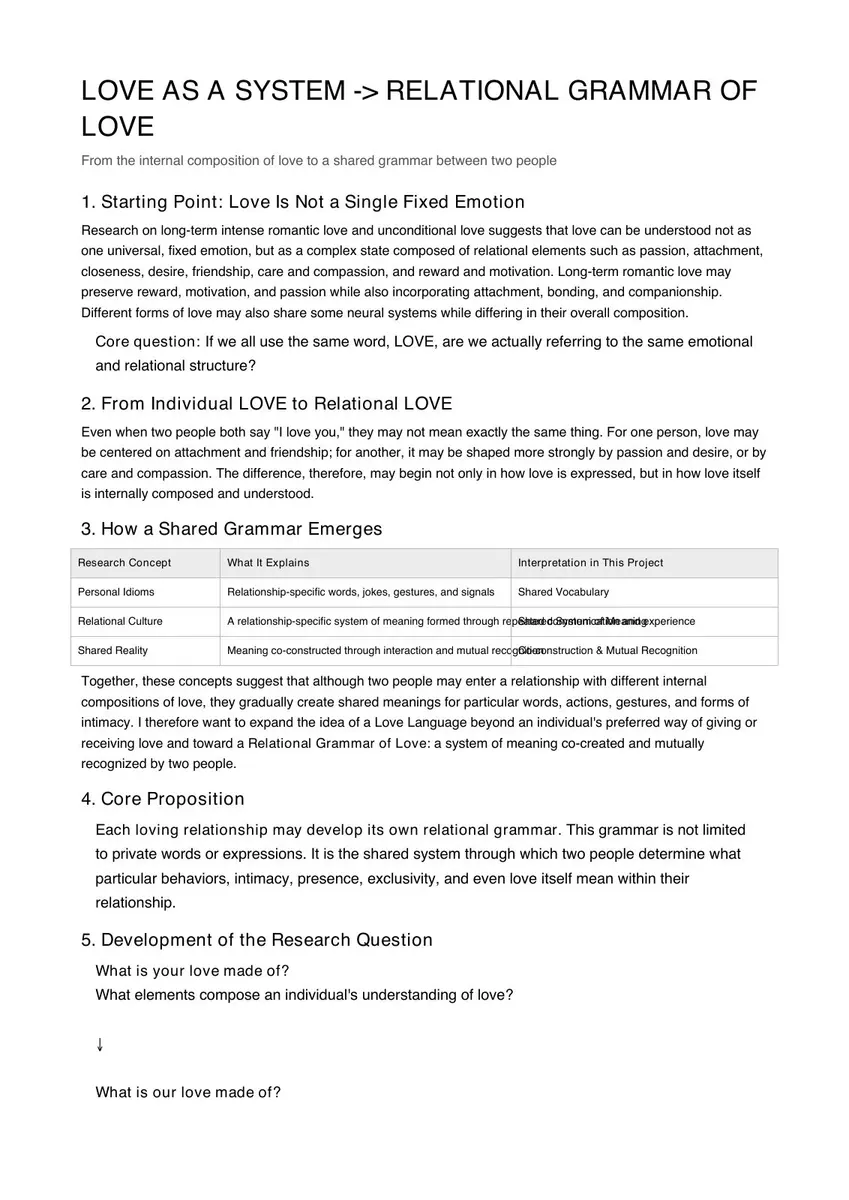
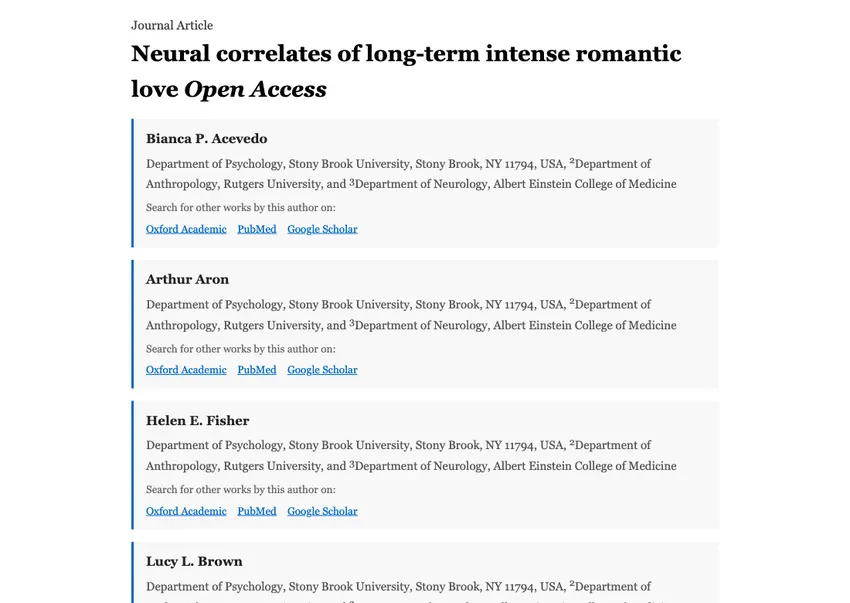
One of the most significant things I have discovered through my research is that love may not be a single, universal, or fixed emotion, but rather a complex state made up of different emotional and relational components. At first, I thought about love languages mainly in terms of how people express and receive love differently. However, my research has led me to a more fundamental question: people may differ not only in how they express love, but also in how they understand and construct the meaning of love itself.
I was particularly interested in research on long-term romantic love, which suggests that love does not simply become weaker over time. Elements such as passion and reward can remain, while attachment, intimacy, friendship, and bonding become increasingly important, changing the overall structure of love. Research on unconditional love also showed me that different forms of love may share some underlying neural systems. These findings led me to think of love not as a single form or emotion, but as something composed of different proportions of passion, attachment, desire, friendship, intimacy, compassion, and care.
What surprised me most was the possibility that although we all use the same phrase, “I love you,” what we actually mean by love may be very different from person to person. Because of this, my research is shifting beyond the question of “How do people express love?” toward questions such as **“What is each person’s love made of?"and "When two people use the same word ‘love,’ are they actually talking about the same thing?”
Weel 6: Provotype
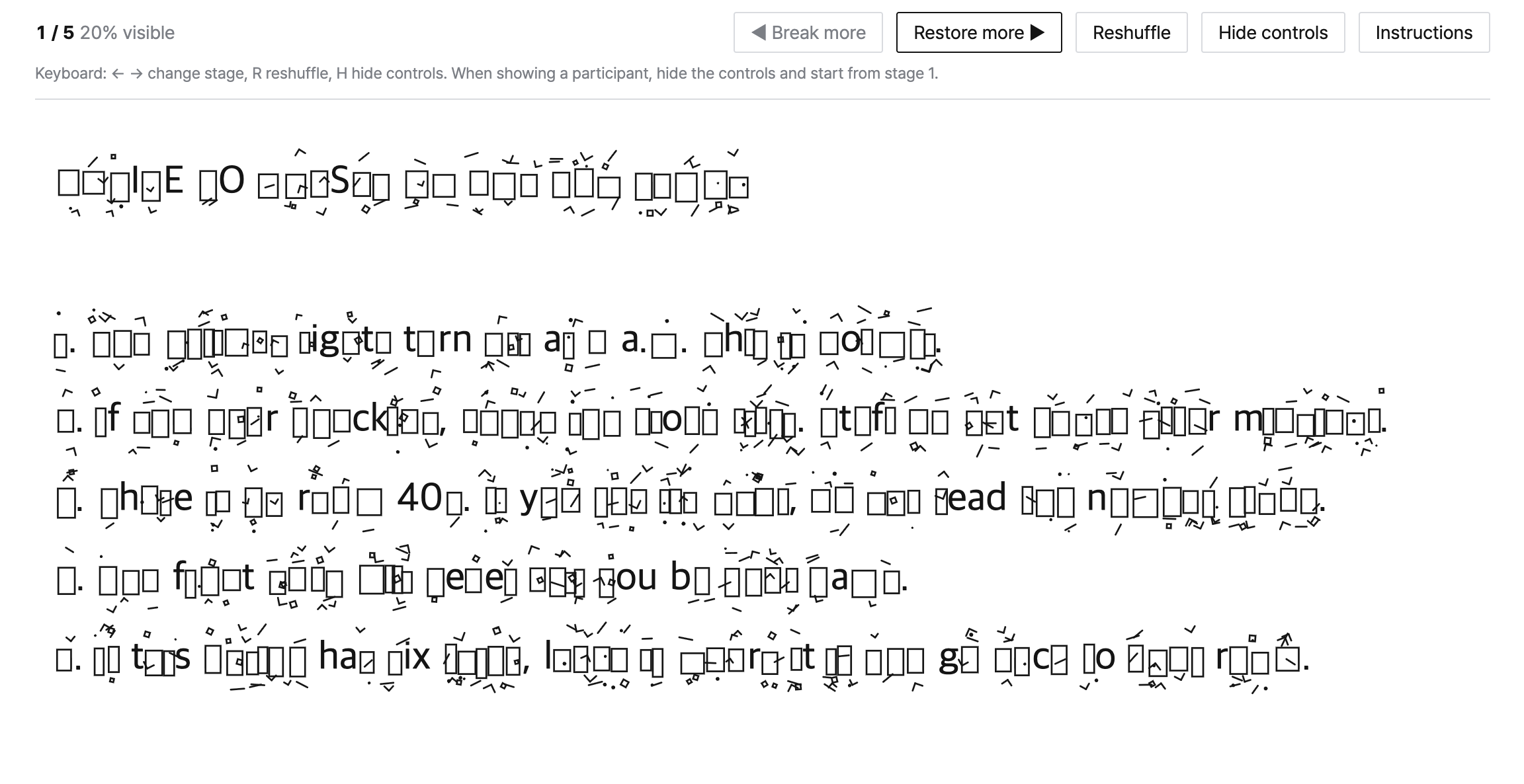
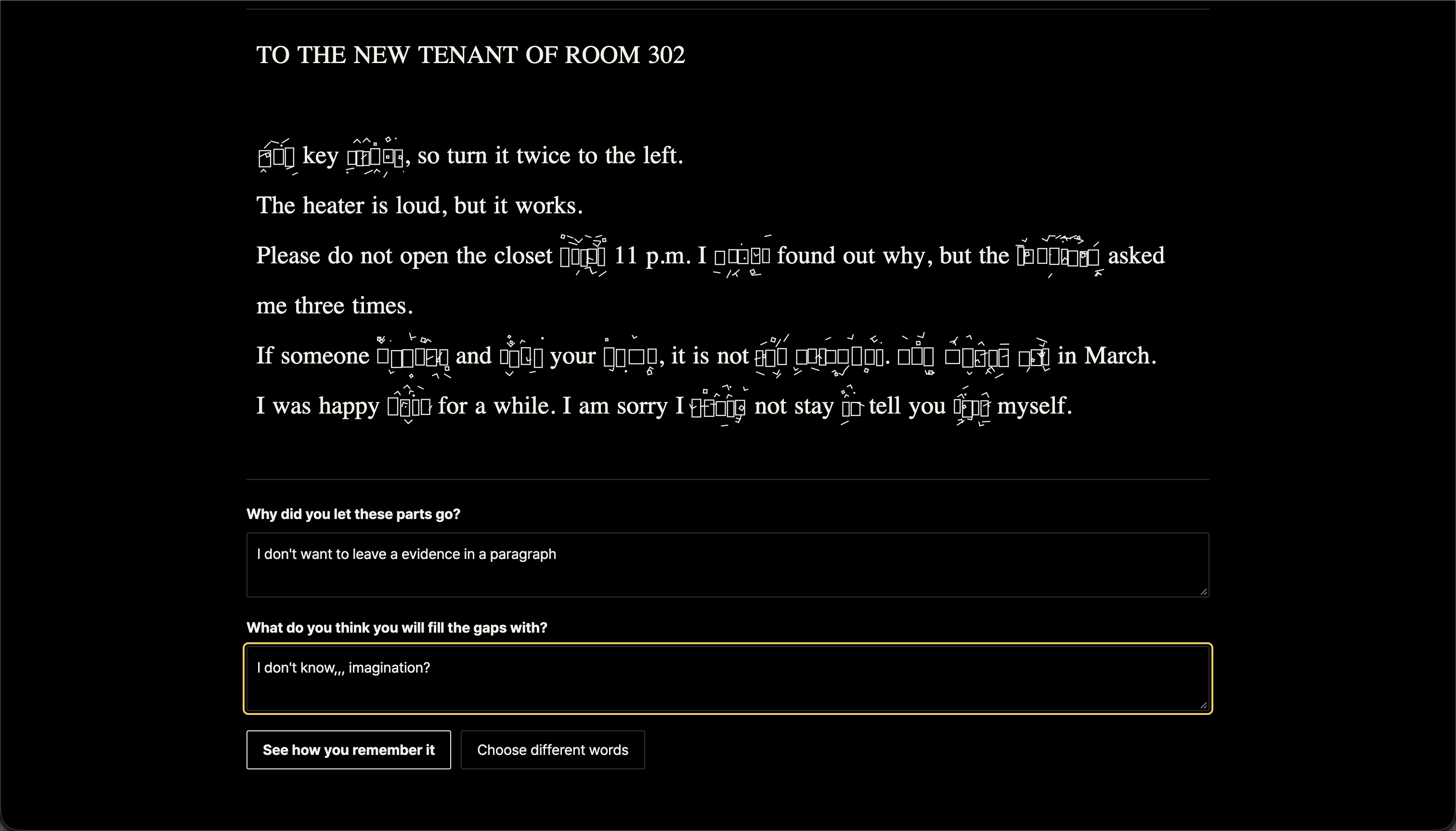
I built three p5.js prototypes that each withhold text in a different way. In Unseen Notice, letters are broken at random and restored over five stages while the participant guesses aloud. In Room 302 Night, the participant chooses at least 12 words to lose from a note, then sees how they "remember" it a week later. In Lights Out, a notice can only be read through a small pool of light and then has to be rewritten from memory.
What I noticed while building them:
A gap that looks broken invites careful guessing. A gap that is filled fluently does not look like a gap at all. In Room 302, losing the single word "not" turns a warning into an instruction, and the remembered sentence still reads perfectly well.
The smallest words carry the most. Negations, numbers and directions feel safe to give up, but they are the ones that change what happens next.
Having only one participant changed the concept. I could not test a sender and a receiver, so the second person became the participant's own memory. That moved the project from "filling in another person" to "filling in for yourself," which feels closer to how idealization actually works.
I moved from intimate messages to rule notices, because in a rule a wrong guess has a consequence. It made the cost of filling in visible.
 Open reference