Week 4
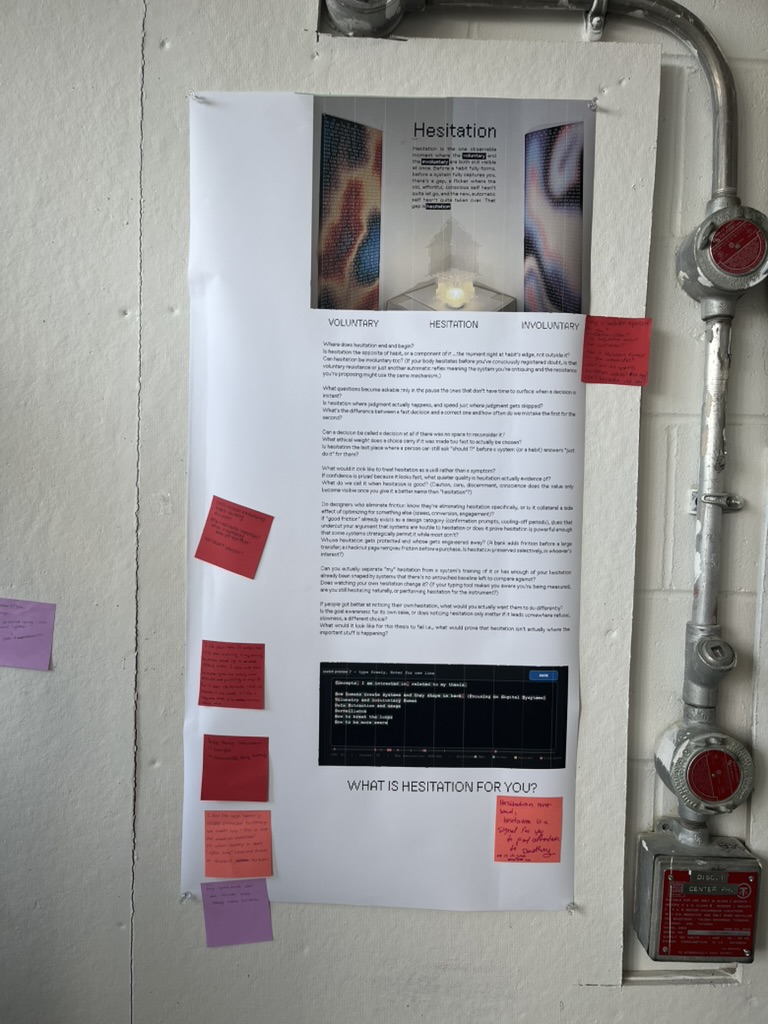
I was thinking of voluntary and involuntary to be a whole and for me hesitation was something else which didn't associate to that or maybe I didn't think of it in that way but hesitation is something which lies between voluntary and involuntary.
Week 3
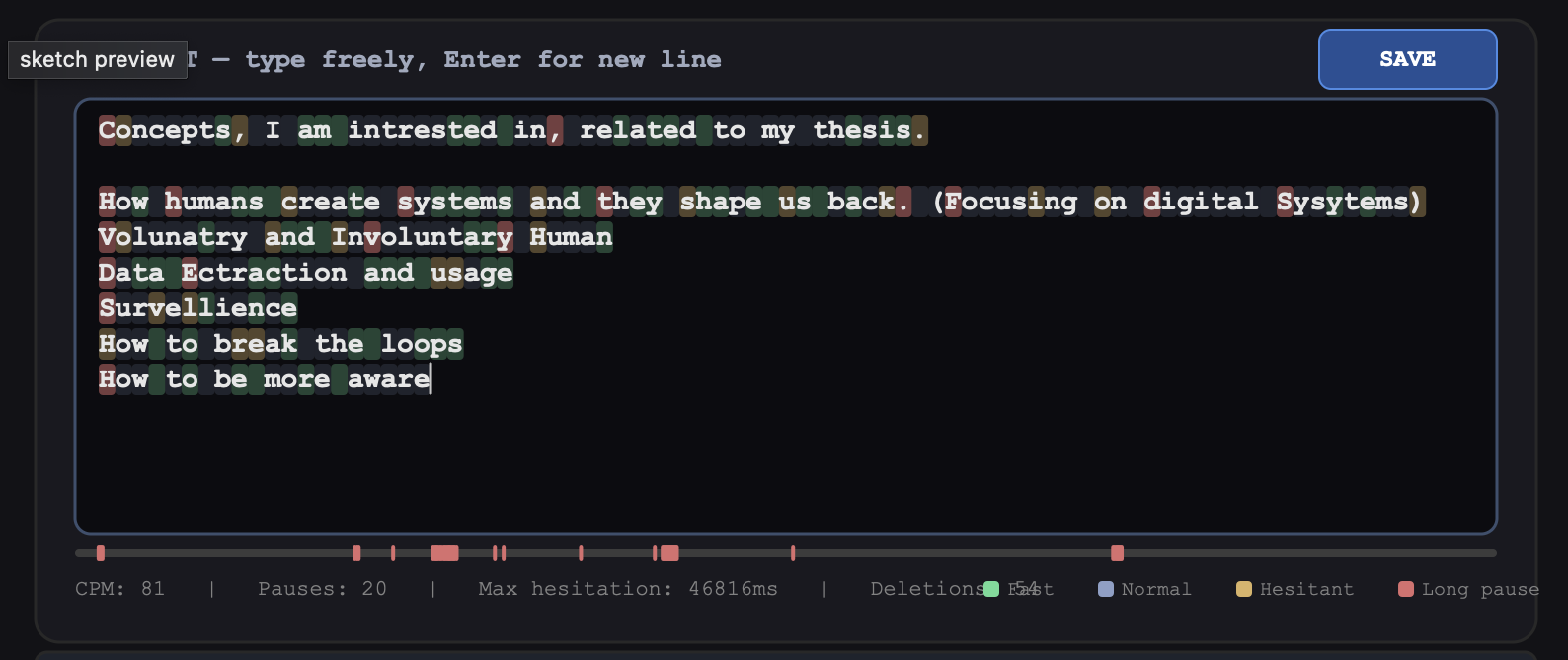
It takes something ambient and unconscious — the rhythm of your typing — and converts it into legible categories: "Fast & Decisive," "Hesitant," "Self-Correcting." That move (raw behavior → timestamped signal → classified label) is the exact pipeline used by keystroke-dynamics authentication, productivity-monitoring software, some fraud-detection systems, and even certain hiring/proctoring tools. They all take something you didn't consciously produce as data and turn it into a verdict about you. This tool does that too. The difference is who's holding the label.
Most critiques of these systems are external — "here's how they watch you." What you're doing is turning the apparatus on yourself first, so you become both the surveilled and the one reading the output. That's a specific, recognized move: sometimes called sousveillance (watching from below/inside rather than from above), and it has a long lineage — quantified-self practices, self-tracking as resistance, Foucault's account of how disciplinary systems work best when the subject starts watching themselves. This tool literalize that last point: you don't need an external observer once you've built the observer into your own writing interface.
Week 2
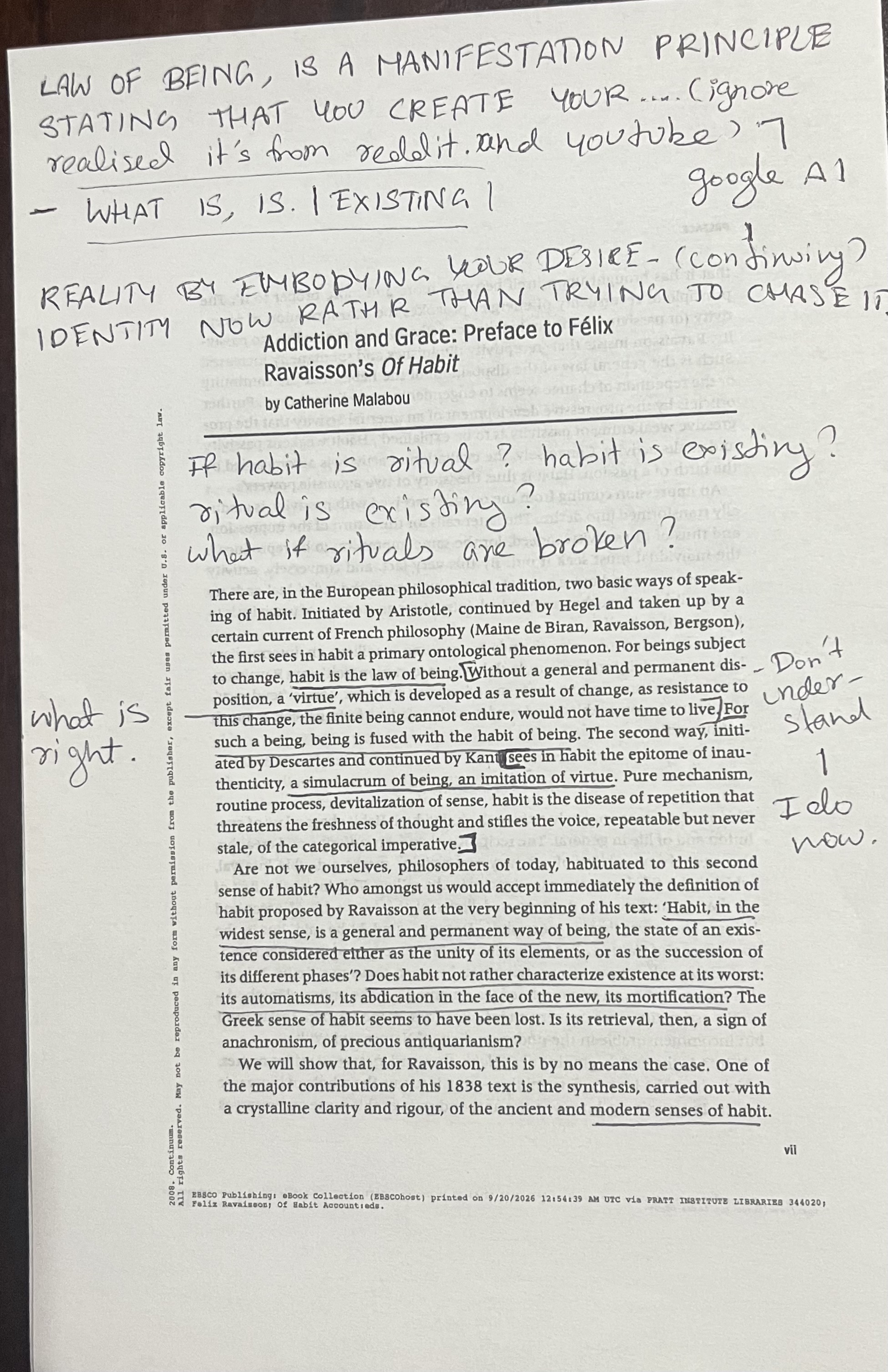
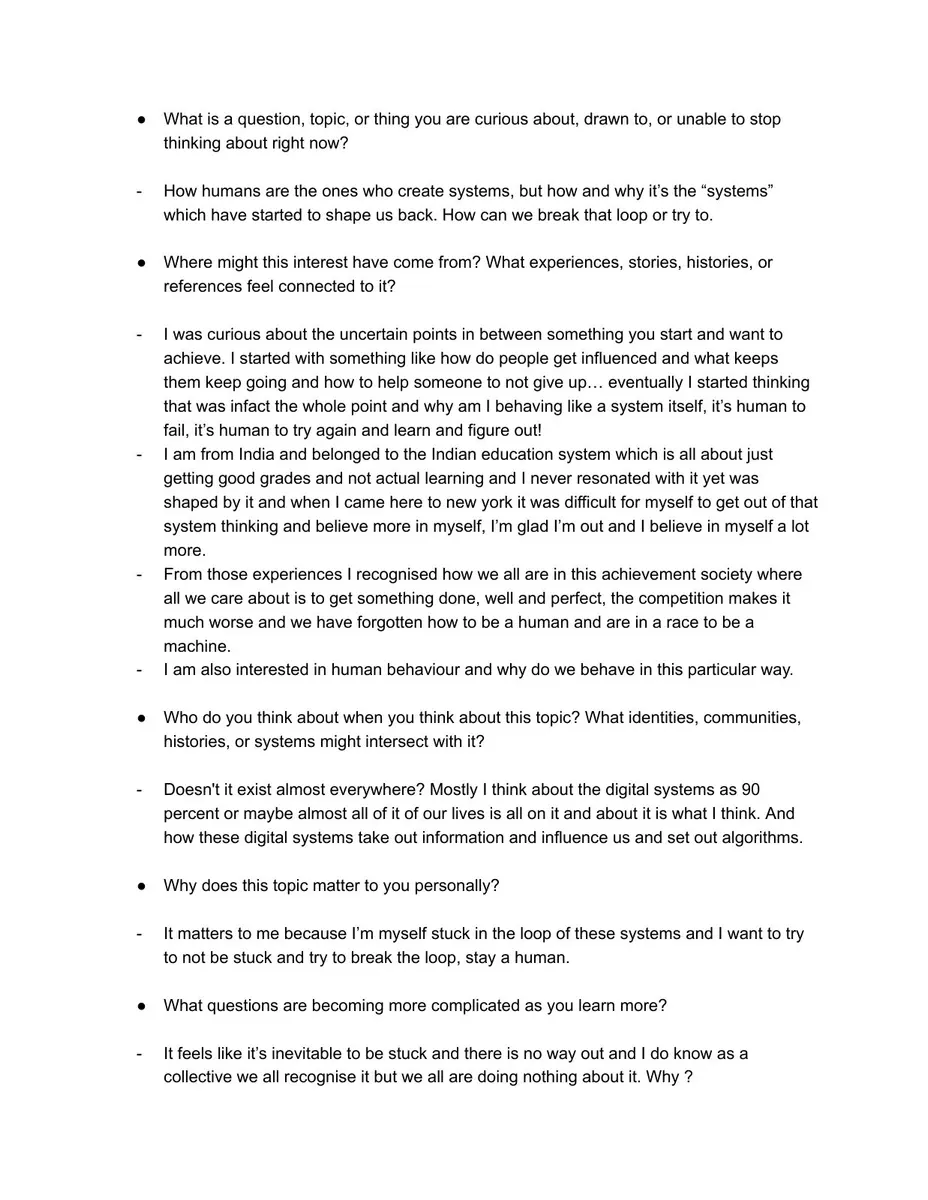
Through my research, I’ve started to understand systems less as something that exists outside of us and more as something that we continuously participate in and reinforce. I began by looking at digital systems such as social media, search engines, notifications, recommendations, and other everyday interfaces, but I gradually became more interested in what happens between the system and the person using it. I noticed that repetition can make behaviors feel automatic, even when we initially chose to participate in them voluntarily.
One thing that surprised me was how difficult it is to separate voluntary behavior from involuntary behavior. A person can consciously choose to do something and still be responding to patterns, expectations, or structures they have become accustomed to. This made me interested in the moment between stimulus and response, especially hesitation. I began thinking of hesitation and friction not simply as interruptions or inefficiencies, but as moments where a person might become aware of their behavior and have an opportunity to make a different choice.
I also realized that I don’t want my research to position humans simply as victims of systems. Humans also sustain systems through their repeated participation. This made the idea of the “loop” more important to my research: systems shape behavior, behavior reinforces systems, and the cycle continues. I am now interested in where that loop can be made visible or interrupted, and what role design can play in creating that moment of awareness without simply becoming another system that tells people what to do.
Week 1
What I started with has entirely changed, I am on the opposite end now.